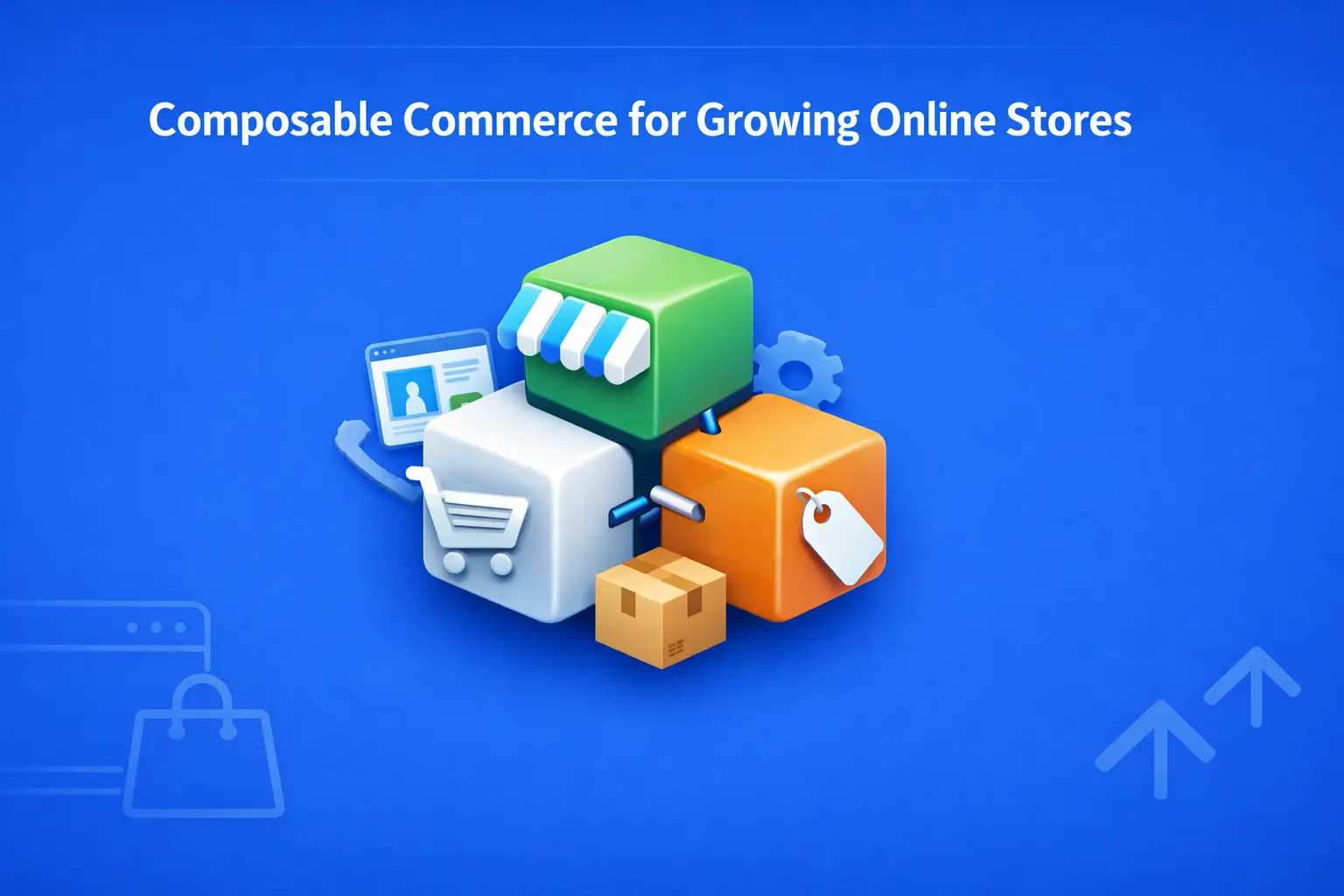
A checkout that converts well, an ERP integration that keeps inventory accurate, and a storefront that loads quickly should not require replacing an entire commerce platform. That is the practical promise of composable commerce: assembling a commerce stack from connected services that each handle a defined job well.
For growing retailers, the appeal is clear. You can add a better search experience, connect a preferred payment provider, introduce B2B account workflows, or improve analytics without treating every business requirement as a full replatforming project. But composable architecture is not simply a matter of buying more tools. It requires deliberate technical ownership, integration planning, and a platform capable of serving as a reliable commerce foundation.
What Composable Commerce Means in Practice
Composable commerce is an approach to eCommerce architecture in which businesses combine independent, interoperable components rather than relying on one tightly bundled system for every function. Those components may include the commerce engine, storefront, content management system, product information management, search, payments, tax, shipping, CRM, ERP, marketing automation, and analytics.
The goal is not to make every system independent at all costs. The goal is to create a stack where important capabilities can be selected, connected, replaced, or expanded without disrupting the entire operation.
A traditional all-in-one platform can be the right fit when requirements are straightforward and the built-in features cover most needs. Composable commerce becomes more valuable when the business has specific operational requirements that generic functionality cannot meet. This is common in B2B operations, multi-store businesses, international sellers, merchants with complex inventory rules, and brands that rely on specialized marketing or fulfillment systems.
For example, a distributor may use nopCommerce for catalog management, customer accounts, pricing rules, and order processing while connecting it to an ERP for real-time stock, a CRM for sales activity, and a search tool for large product catalogs. The store remains the customer-facing transaction hub, while connected services handle specialized functions.
Why Retailers Choose a Composable Commerce Model
The strongest reason to adopt composable commerce is control. Instead of accepting limitations in a prepackaged stack, retailers can choose technology based on commercial priorities and operational fit.
That flexibility can improve speed to market. If a merchant needs a product feed for Google Shopping or Facebook Catalog, a GA4 implementation with meaningful event tracking, or a Klaviyo connection for lifecycle campaigns, those capabilities can be added through a supported plugin, API integration, or custom development project. The core commerce operation does not need to be rebuilt to support each initiative.
Composable architecture can also reduce long-term platform risk. Businesses evolve. A payment provider changes terms, an ERP becomes inadequate, a new warehouse system is introduced, or an acquisition creates a need for multi-store management. With a well-planned architecture, the business can address a specific layer rather than beginning another costly platform migration.
Performance is another consideration. A composable strategy allows teams to focus on the parts of the customer journey that affect revenue. Faster category pages, better on-site search, a simpler checkout flow, accurate delivery options, and relevant product recommendations can be improved individually. That focus supports stronger conversion rates without turning the storefront into an overloaded collection of features.
The Trade-Off: Flexibility Requires Governance
Composable commerce is not automatically simpler. Every new service introduces decisions around data ownership, authentication, error handling, monitoring, release management, and support responsibility. A stack with five poorly coordinated tools can create more friction than a single platform with a few manageable limitations.
The key question is not, “How many best-of-breed tools can we add?” It is, “Which capabilities create enough commercial value to justify another integration?”
Before adding a component, identify the system of record. Product descriptions may belong in a PIM, inventory levels in an ERP, customer consent in a CRM, and order status in the commerce platform. When two systems are both allowed to update the same field without clear rules, data conflicts quickly affect customer experience and operations.
Integration reliability matters just as much as feature selection. A real-time inventory connection may be necessary for a high-volume store with limited stock. For other businesses, scheduled synchronization may be more stable and cost-effective. The correct design depends on order volume, catalog size, fulfillment processes, and the business impact of delayed data.
Security must be part of the plan from the start. API credentials should be protected, permissions limited by role, software updates managed consistently, and logs reviewed for failures or unusual activity. A composable setup has more connection points, so it needs disciplined hosting, maintenance, and monitoring.
Where nopCommerce Fits in a Composable Stack
nopCommerce is well suited to a composable commerce strategy because it provides a flexible, open-source commerce core without forcing merchants into a closed ecosystem. It supports catalog and order management, customer accounts, promotions, multi-store configurations, B2B capabilities, and a broad extension model that can be adapted to specific workflows.
For many merchants, the platform becomes the operational center for selling while integrations extend its reach. A business can connect payment gateways, shipping carriers, ERP and CRM platforms, marketing systems, tax services, search providers, and custom internal applications based on its actual requirements.
This approach is particularly useful when a store needs functions that are not standard across every retail business. A manufacturer may need customer-specific pricing and approval workflows. A wholesale operation may need purchase orders, sales representative accounts, and inventory data from multiple warehouses. A consumer brand may prioritize product bundles, subscription logic, loyalty programs, and high-quality campaign tracking. These requirements do not always justify a new platform, but they often require more than default settings.
The open-source nature of nopCommerce also gives businesses greater control over customizations and infrastructure. That control should be used carefully. Core modifications can complicate future upgrades if they are not designed and documented properly. Whenever possible, functionality should be developed as maintainable plugins, integrations, and theme-level enhancements rather than changes that make version upgrades unnecessarily difficult.
How to Build a Practical Composable Commerce Roadmap
Start with business constraints, not a technology shopping list. Review where the current store loses time, revenue, or accuracy. Common issues include slow page performance, manual order entry, inconsistent inventory, weak site search, checkout abandonment, disconnected marketing data, and limited reporting.
Next, map the customer and operational journeys. Follow a product from catalog setup through inventory updates, merchandising, purchase, fulfillment, returns, customer service, and reporting. This reveals which systems already hold critical data and where teams are relying on spreadsheets or manual workarounds.
Then define the minimum architecture needed to solve the highest-value problem. If inventory errors are causing oversells, prioritize the ERP connection and reconciliation rules. If acquisition costs are increasing, focus on product feed quality, analytics events, landing-page performance, and marketing automation. Avoid launching multiple integrations at once unless there is a clear dependency and sufficient testing capacity.
Each integration should have measurable acceptance criteria. That may include inventory synchronization within a defined time window, successful order export rates, checkout response time, complete GA4 purchase events, or a reduction in manual support tasks. Measurable criteria keep technical work tied to commercial outcomes.
Finally, establish an operating model. Someone must own vendor coordination, credential renewal, release testing, exception handling, and ongoing platform updates. For merchants without a large internal development team, a specialized nopCommerce partner such as noptech can provide the implementation and maintenance coverage needed to keep custom integrations, hosting, and platform upgrades aligned.
When Composable Commerce Is Not the Right Next Step
A composable model may be premature if the current store has unresolved fundamentals. If product data is incomplete, fulfillment processes are inconsistent, or the team has no capacity to manage technology vendors, adding more systems can amplify the problem.
It may also be unnecessary when a platform’s native functionality already meets the business need. A simple, well-managed setup is often better than an elaborate architecture with little operational benefit. The right level of composability is based on real complexity, not on architecture trends.
The most effective commerce stack is one your team can operate confidently. Build it around the next meaningful business constraint, document how data moves, and make every new component earn its place through better performance, clearer operations, or stronger customer experiences.