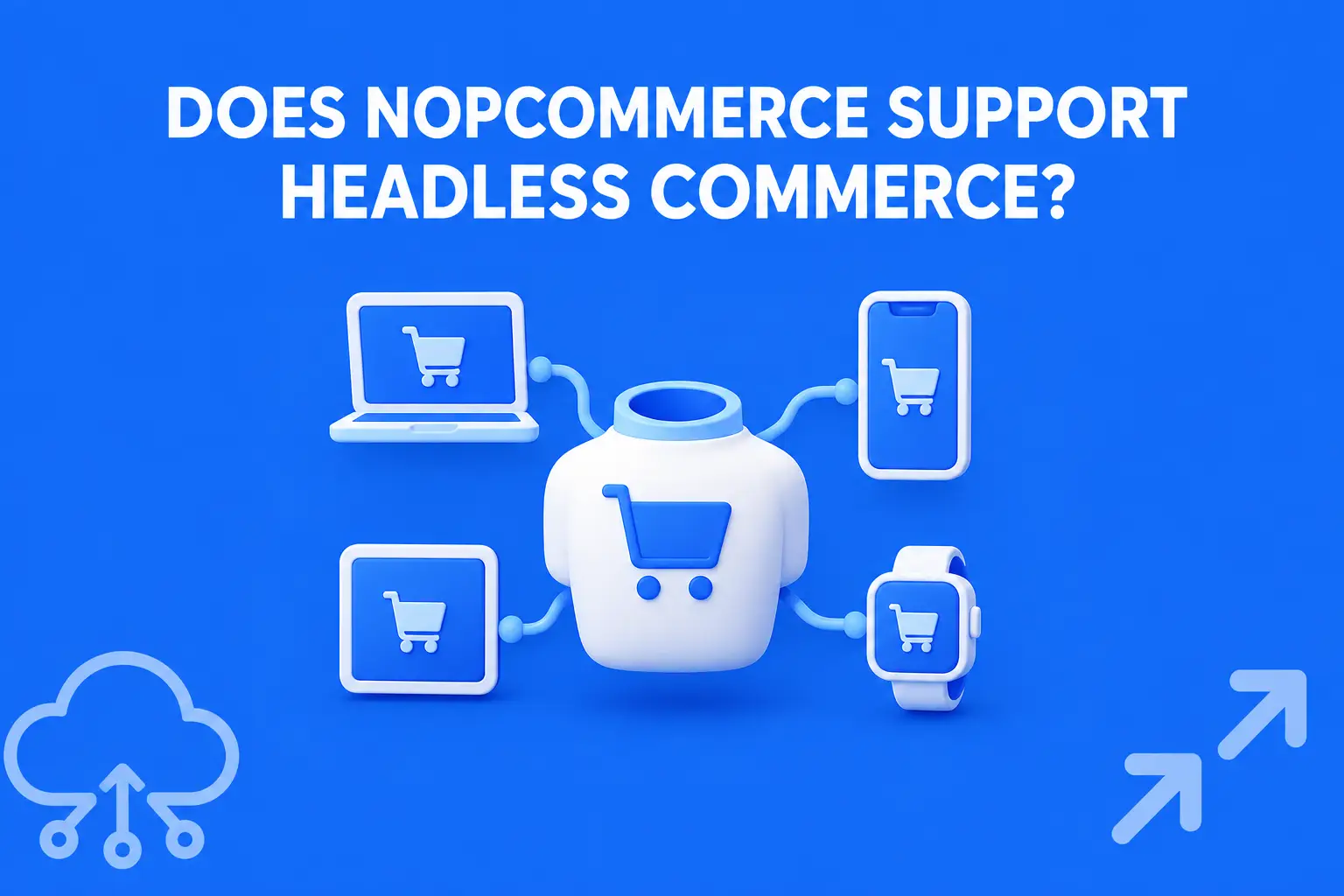
A retailer may need one commerce engine to power a fast web storefront, a native mobile app, an in-store kiosk, and a customer portal. That requirement changes the question from whether a theme looks right to whether the platform can reliably serve commerce data wherever it is needed. So, does nopCommerce support headless commerce? Yes, but the practical answer depends on how much storefront independence, API coverage, and custom integration work your business requires.
nopCommerce is a flexible, open-source commerce platform with an established presentation layer and a mature back-office foundation. A headless implementation separates that presentation layer from the commerce engine. The storefront becomes an independent application, while nopCommerce continues to manage products, customers, pricing, promotions, orders, inventory workflows, and administration.
For businesses with ambitious customer experiences or multiple sales touchpoints, that separation can be a meaningful advantage. It is not automatically the right architecture for every store, however. A headless build introduces development, hosting, security, and operational responsibilities that should produce a clear commercial return.
Does nopCommerce support headless commerce in practice?
nopCommerce can support a headless architecture through its API capabilities and custom development. Its web API framework allows external applications to interact with commerce data and operations. Development teams can use it as the connection point between nopCommerce and a custom frontend built with technologies such as React, Next.js, Vue, Angular, or a native mobile framework.
The platform's open-source codebase is equally relevant. When an API endpoint, workflow, or business rule is not available out of the box, a qualified nopCommerce development team can extend the platform to expose the required data securely. That may include custom product attributes, customer-specific pricing, B2B approval logic, ERP inventory availability, or a specialized checkout step.
In other words, nopCommerce is not limited to its default Razor-based storefront. It can operate as the commerce backend for a decoupled experience. The scope and quality of that implementation matter more than the label headless.
What stays in nopCommerce
In a headless model, nopCommerce remains the source of truth for core commerce functions. Store managers can still work from the familiar administration area to maintain the catalog, process orders, manage customers, configure tax and shipping, run discounts, and review store activity.
This distinction is valuable for operations teams. A custom frontend should not force staff to manage products in a separate system or create duplicate order records. The goal is to modernize the customer-facing experience while preserving a dependable commerce operating layer.
Many existing nopCommerce plugins can still add value, particularly when they enhance administrative capabilities, connect payment or shipping services, integrate marketing tools, or synchronize external systems. Frontend-oriented plugins and theme features may require extra work because a decoupled storefront will not automatically render their visual components.
What moves to the frontend
The external frontend owns the customer experience: page layout, navigation, search interface, category pages, product presentation, content modules, and interactions. Depending on the architecture, it may also handle server-side rendering, caching, image optimization, personalization logic, and the browser-side checkout experience.
That freedom enables teams to design around conversion goals rather than platform theme constraints. A merchandising team might require editorial landing pages with dynamic product selections. A B2B seller may need a customer portal with quick order forms, account-specific catalogs, and procurement-friendly approval states. A consumer brand may prioritize Core Web Vitals, mobile-first browsing, and campaign pages that marketing can deploy quickly.
The frontend is also where performance decisions become highly visible. A well-engineered headless storefront can reduce unnecessary page weight, pre-render high-value pages, and deliver content from locations closer to shoppers. But decoupling alone does not make a site fast. Poor API design, excessive third-party scripts, weak caching, or an overloaded hosting environment can offset the expected gains.
Where headless nopCommerce delivers the strongest value
Headless commerce makes the most sense when a business has requirements that a conventional nopCommerce theme cannot address efficiently. The strongest cases usually involve multiple customer channels, highly customized journeys, or a need to separate frontend release cycles from backend commerce operations.
For example, a manufacturer selling through distributors and direct channels may use nopCommerce for product, account, and order management while providing distinct storefront experiences for each audience. A mobile-led retailer can use the same backend for its web store and app without rebuilding commerce logic twice. An enterprise organization can connect a content platform, CRM, ERP, search provider, and analytics stack while keeping nopCommerce at the center of transactional activity.
Headless can also help when frontend speed is a direct revenue concern. Faster category, product, and landing pages can improve shopper engagement and reduce the risk of paid traffic leaving before content loads. The business case should be measured in outcomes such as conversion rate, mobile performance, campaign agility, customer retention, and lower maintenance friction, not simply the appeal of newer technology.
The trade-offs to plan for before decoupling
A headless nopCommerce project is not a theme replacement. It is a software architecture decision. The initial build commonly requires backend development, frontend engineering, API documentation, test coverage, deployment processes, and monitoring across multiple applications.
Checkout deserves particular attention. Products, cart actions, promotions, shipping methods, payment processing, taxes, customer authentication, and order confirmation must work consistently between the storefront and nopCommerce. If the store uses complex rules such as tier pricing, reward points, recurring payments, pickup locations, or customer-specific terms, each workflow should be defined and tested early.
Security also becomes broader. API endpoints need appropriate authentication, authorization, rate limiting, validation, logging, and monitoring. Sensitive customer and order data should only be exposed when necessary. The frontend, backend, hosting environment, and third-party integrations all need a clear ownership model for updates and incident response.
There is a content-management consideration as well. nopCommerce handles commerce content effectively, but businesses with editorial-heavy experiences may choose to connect a dedicated CMS. That can give marketing teams more flexibility, but it creates another integration to maintain. The right setup depends on who publishes content, how often campaigns change, and whether content needs to be shared across multiple channels.
A practical architecture for nopCommerce headless commerce
The most reliable approach is to start with the business workflow, then select the technical components that support it. nopCommerce should remain responsible for the commerce rules it already handles well. The frontend should focus on experience delivery. Connected systems should have clear responsibilities rather than overlapping ownership of products, prices, inventory, or customer data.
A typical implementation includes nopCommerce as the commerce core, a custom web or mobile frontend, secure APIs between the applications, and integrations for systems such as ERP, CRM, PIM, search, payment, shipping, GA4, and marketing automation. Hosting should be sized for both the nopCommerce application and the frontend delivery layer, with attention to database performance, caching, backups, SSL, uptime monitoring, and deployment reliability.
Before development begins, document the data flows. Define where inventory is updated, how prices are calculated, which system owns product enrichment, when order status changes are shared, and how failures are retried. This work may seem operational, but it prevents the fragmented back-office processes that headless commerce is often meant to solve.
Build APIs around real storefront needs
Avoid exposing every database field simply because it is available. Design endpoints around the data the storefront needs to render a page or complete a task. Product listing pages, product detail pages, cart updates, customer account areas, and checkout each have different performance and security requirements.
This approach reduces unnecessary payloads and makes the API easier to maintain. It also creates a cleaner path for future channels, such as mobile apps, partner portals, or marketplace integrations. When commerce rules change, teams can update a controlled service layer instead of rewriting logic across every frontend.
Treat deployment and support as part of the build
A decoupled system has more moving parts, so release management needs discipline. Frontend and backend updates should be versioned, tested in staging, and monitored after launch. API changes need compatibility planning so a backend release does not unexpectedly break a live storefront.
Managed hosting and ongoing technical support are especially useful here. A specialist team such as noptech can coordinate nopCommerce development, custom API work, infrastructure, performance optimization, and long-term maintenance instead of leaving internal teams to manage disconnected vendors.
Is headless the right choice for your nopCommerce store?
Choose a conventional nopCommerce storefront when your business needs a capable, cost-conscious store launch, has standard customer journeys, and can achieve its goals through a premium theme and targeted plugin or custom development. This route often provides the best time-to-market and the lowest operational complexity.
Consider headless when your storefront is a strategic product, not just a sales interface. It is particularly relevant when you need distinct experiences across channels, advanced personalization, a modern JavaScript frontend, intensive content marketing, complex B2B functionality, or performance controls beyond what a traditional theme architecture can reasonably provide.
The strongest first step is to map the revenue opportunity against the added technical responsibility. If headless will help your team launch faster, convert better, serve more channels, or simplify critical integrations, it can turn nopCommerce into a flexible commerce foundation built for the next stage of growth.