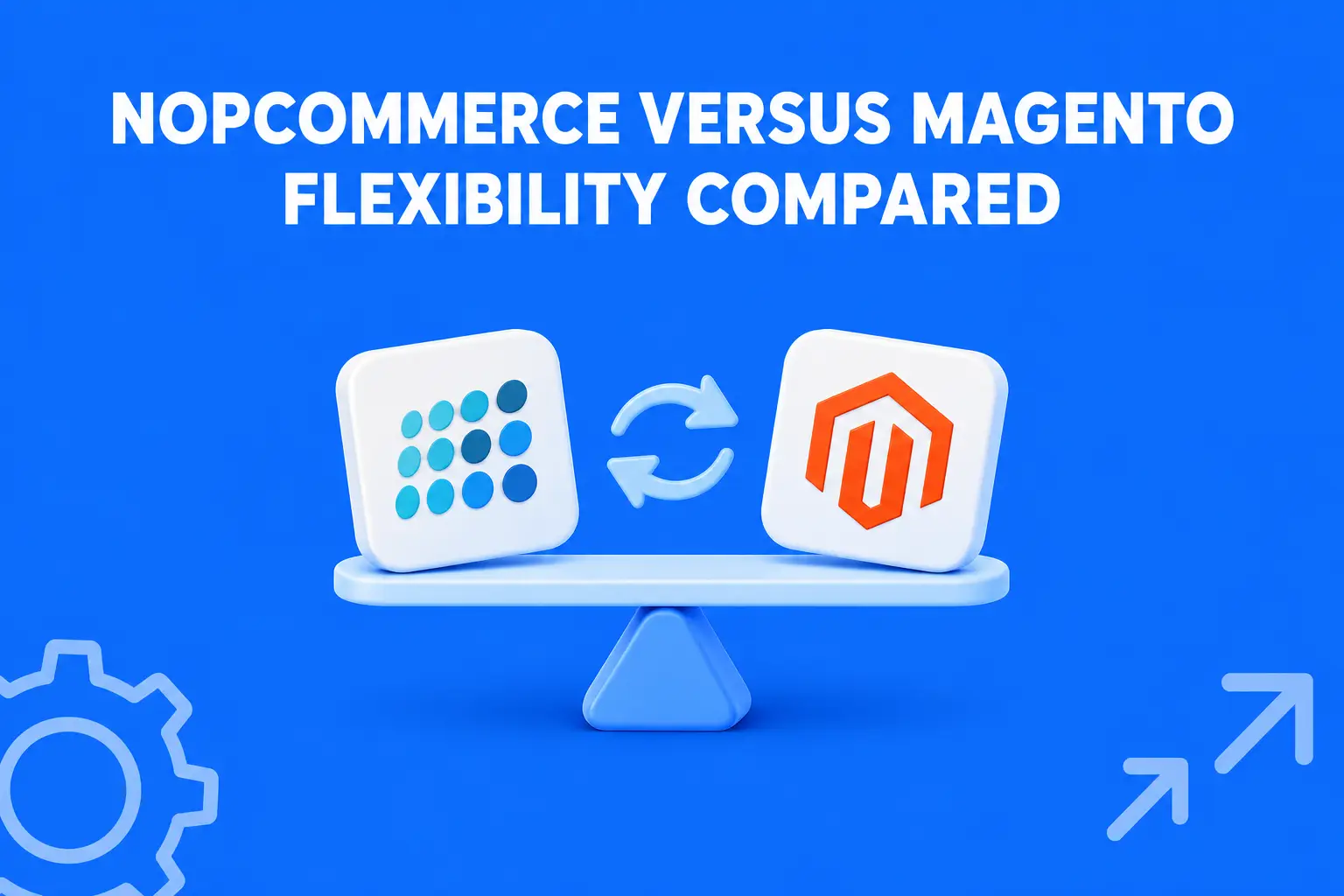
A commerce platform can look flexible in a feature comparison and still become expensive to change when a new ERP, pricing model, fulfillment rule, or storefront requirement arrives. The real question in nopCommerce versus Magento flexibility is not which platform has more extensions. It is which platform gives your business the control to make changes at a sustainable cost, with an architecture your team can operate confidently.
For growing and established merchants, flexibility affects more than design. It determines how quickly the store can support new product types, customer groups, B2B workflows, marketing channels, tax rules, integrations, and performance requirements. Both nopCommerce and Magento can be customized extensively. Their differences emerge in the technology stack, implementation approach, hosting model, and long-term maintenance burden.
nopCommerce Versus Magento Flexibility in Practice
Magento has earned its reputation as a highly configurable commerce platform. Its ecosystem has supported complex catalogs, multiple brands, international selling, advanced promotional logic, and customized checkout experiences for years. Magento Open Source and Adobe Commerce provide a wide range of capabilities, while the extension marketplace and large developer community give merchants many routes to expand functionality.
That breadth can also create architectural choices that need close control. A Magento store may combine core customizations, third-party modules, custom themes, API middleware, and platform-specific hosting tools. Each element can be valuable, but the store needs disciplined development standards, testing, and release management to stay stable through upgrades. Flexibility is available, but it often requires more governance to prevent extension conflicts, slow queries, or difficult upgrade paths.
nopCommerce takes a different route. Built on ASP.NET Core, it gives businesses access to the Microsoft technology ecosystem while keeping the commerce application open source and self-hosted. Merchants can modify the source code, develop plugins, build custom themes, create integrations, and control their own deployment environment. For organizations already using .NET, Microsoft SQL Server, Azure, Active Directory, or internally developed business systems, that alignment can reduce friction across the commerce stack.
The practical distinction is not that one platform is customizable and the other is not. Magento is often selected when an organization has an existing Magento team, an Adobe Commerce strategy, or unusually deep requirements already supported by its ecosystem. nopCommerce is often a stronger fit when a business wants open-source control within a modern .NET environment and prefers a cleaner, more focused path to custom development and long-term ownership.
Flexibility Starts With the Development Model
A platform is flexible when developers can add business logic without turning every future update into a redevelopment project. nopCommerce supports extension through plugins, widgets, themes, scheduled tasks, API integrations, and custom code. This lets a development team isolate many store-specific functions from the core platform, which can make upgrades easier to plan and test.
For example, a distributor may need customer-specific pricing from an ERP, a sales-representative ordering workflow, custom purchase approval rules, and inventory visibility by warehouse. Those requirements do not need to be forced into a generic storefront template. They can be designed as targeted extensions that communicate with the relevant back-office systems while preserving a manageable commerce codebase.
Magento offers similar possibilities through modules, observers, plugins, themes, and APIs. However, Magento customization can become more complex when multiple extensions modify the same checkout, catalog, pricing, or indexing behavior. The platform can support highly specialized implementations, but technical teams need to assess code quality before installing modules and establish clear rules for custom development.
For either platform, the best flexibility comes from an implementation plan that separates essential custom logic from standard capabilities. If an existing feature solves the business requirement, use it. If a workflow creates a competitive advantage or removes a costly manual process, custom development may be justified. Building every request from scratch is not flexibility. It is future maintenance debt.
Integrations Are the Real Test
Most commerce businesses reach their flexibility limit in the back office, not on the product page. A store must exchange accurate information with ERP, CRM, PIM, warehouse management, shipping, payment, tax, marketing automation, and analytics systems. When these connections are unreliable, teams resort to spreadsheets, manual order updates, and delayed customer communication.
nopCommerce is well suited to businesses that need tailored integrations with Microsoft-based or API-driven systems. A custom connector can synchronize products, inventory, orders, customer records, pricing, shipment updates, and return data according to the business's actual process. This matters for B2B sellers that work with contract pricing, account hierarchies, credit terms, quote requests, or complex fulfillment rules.
Magento also has mature API capabilities and a large catalog of integration options. For common tools, a prebuilt connector may accelerate implementation. The trade-off is that merchants should confirm how the connector handles data ownership, retries, security, performance, and platform upgrades. A connector that works during launch but fails during a high-volume sales period is not a flexible solution.
The strongest approach is to define integration requirements before selecting the platform or extensions. Identify the source of truth for inventory, customer data, product attributes, and orders. Then determine how often each data set must synchronize and what happens when an external system is unavailable. Those decisions have a greater impact on operational flexibility than the number of available plugins.
Storefront and Merchandising Control
Both platforms allow extensive storefront changes, but the effort depends on how far the design moves from the default structure. Magento's frontend architecture can support sophisticated brand experiences, headless implementations, and custom content experiences. It is a capable option for businesses with the budget and technical resources to manage a larger frontend program.
nopCommerce offers practical flexibility for merchants that need a fast, conversion-focused storefront without adding unnecessary complexity. A custom theme can align the site with brand guidelines while improving mobile navigation, search behavior, category merchandising, product detail pages, and checkout flow. Plugins can add focused capabilities such as product labels, advanced search, wish lists, recurring payments, feeds, reviews, and marketing integrations.
The key is to avoid treating frontend flexibility as a reason to overload the site. Every script, app, and design effect should earn its place through better usability, conversion performance, or a clear operational need. A lean storefront with efficient images, well-structured templates, and controlled third-party scripts usually delivers more commercial value than a visually ambitious site that loads slowly.
Hosting and Performance Affect What You Can Change
Flexibility also depends on infrastructure. A platform may support a new sales channel, product feed, or seasonal campaign in theory, but the change has little value if pages slow down under load or deployments create downtime.
Magento commonly requires carefully sized hosting, caching, search services, database tuning, and deployment procedures, particularly for stores with large catalogs or high traffic. This does not make Magento unsuitable. It means infrastructure planning is a central part of the implementation rather than an afterthought.
nopCommerce gives merchants control over hosting on Windows or Linux environments supported by ASP.NET Core. With properly configured VPS or dedicated resources, CDN support, caching, database optimization, monitoring, backups, and a tested release process, stores can scale in a controlled way. The platform's flexibility is especially useful for companies that want to own their infrastructure decisions instead of being confined to a proprietary SaaS environment.
A development partner should evaluate performance before major changes are released. Load time, database queries, plugin behavior, image delivery, search indexing, API response times, and error logs all reveal whether a new capability will improve the business or introduce risk.
Which Platform Fits Your Operating Model?
Choose Magento when its existing ecosystem, Adobe Commerce capabilities, or your current internal expertise clearly match your requirements. It can be a sensible choice for organizations prepared to invest in specialized Magento development, structured release management, and the infrastructure needed for a complex implementation.
Choose nopCommerce when you want an open-source platform that supports deep customization within the .NET ecosystem, with direct control over source code, hosting, integrations, and store operations. It is particularly compelling for merchants that need custom B2B functionality, Microsoft-system integrations, multi-store architecture, or a long-term platform that can be adapted without surrendering ownership of the stack.
The right decision should be based on the workflows that produce revenue and reduce operational work: how orders flow to fulfillment, how customers receive negotiated pricing, how product data is managed, and how quickly the team can release improvements. A focused technical audit can turn those requirements into a platform roadmap. For businesses committed to nopCommerce, a specialist partner such as noptech can help translate that roadmap into custom development, managed hosting, performance improvements, and maintainable integrations.