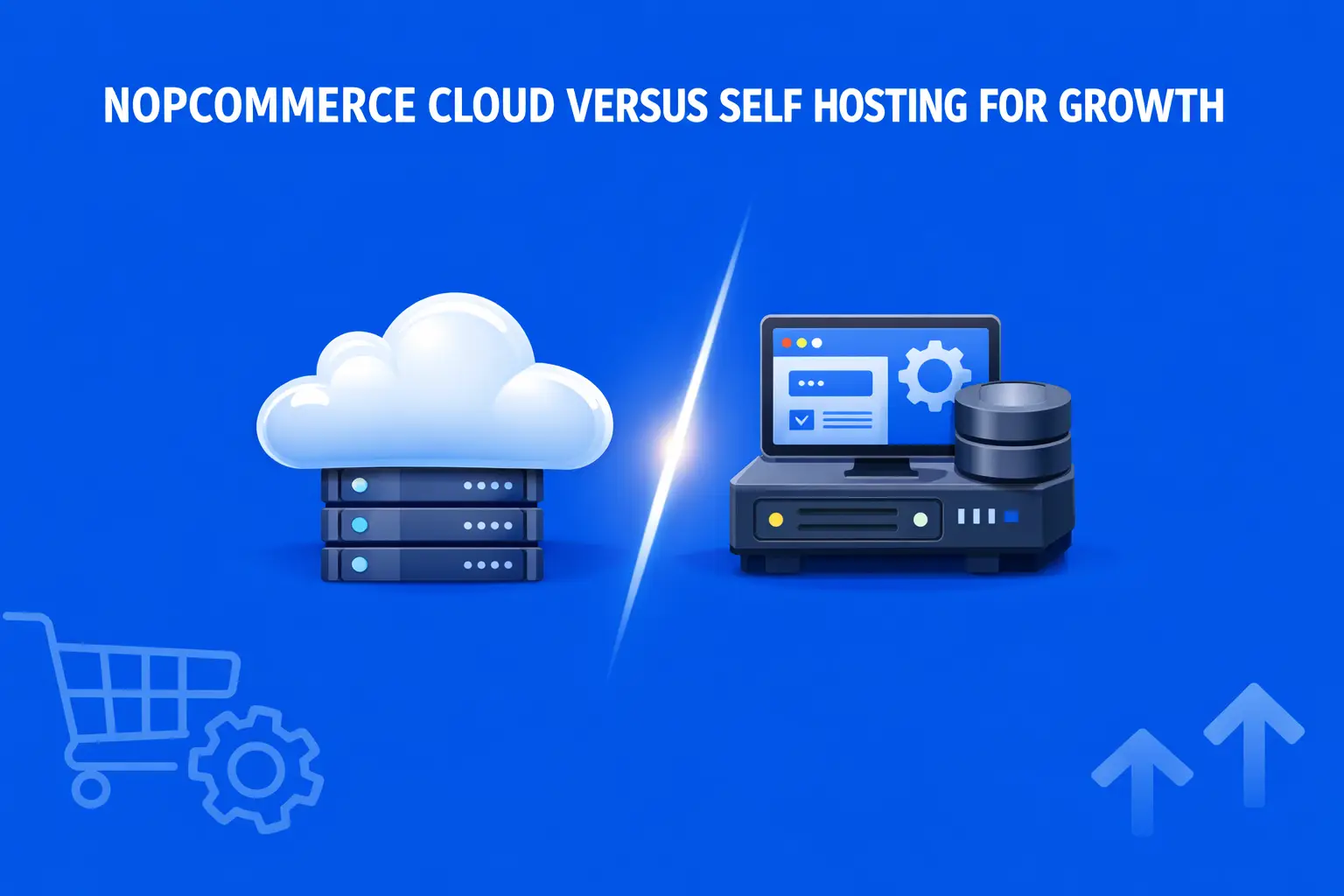
A slow product page during a campaign, a checkout outage at peak volume, or a failed ERP sync can turn hosting into a revenue problem quickly. The choice between nopCommerce cloud versus self hosting determines who manages the infrastructure behind those moments, how much control your team retains, and how easily the store can evolve as operations become more complex.
Neither model is automatically better. Cloud hosting can reduce infrastructure administration and speed up deployment. Self hosting can provide more control over server configuration, security policies, integrations, and resource allocation. The right choice depends on your store's traffic profile, technical requirements, internal capabilities, and growth plans.
nopCommerce Cloud Versus Self Hosting: The Core Difference
With cloud hosting, your nopCommerce store runs in an environment managed by a hosting provider. The provider typically handles the underlying servers, core infrastructure monitoring, and some level of maintenance. Depending on the plan, this may include backups, SSL configuration, updates to the operating environment, and resource scaling.
Self hosting means your business chooses and controls the hosting environment directly. That can be a virtual private server, a virtual dedicated server, dedicated hardware, or cloud infrastructure configured specifically for your store. Your team, internal IT partner, or managed nopCommerce provider is responsible for configuring, securing, monitoring, and maintaining that environment.
The distinction is not simply “hands-off” versus “hands-on.” It is about operational responsibility. Cloud hosting shifts more infrastructure tasks to a provider. Self hosting gives you more authority over how the environment is built and operated.
When Cloud Hosting Makes Sense
Cloud hosting is often a practical starting point for merchants that need a dependable store without building an infrastructure management process from scratch. A growing retailer with a straightforward catalog, standard payment processing, and limited custom integrations may benefit from the faster setup and predictable monthly costs of a managed cloud plan.
The strongest cloud option should still provide clear answers about performance limits. Ask whether CPU, RAM, storage, database capacity, bandwidth, and concurrent processes are allocated or shared. A store can look stable in normal conditions yet slow down significantly when a promotion, email campaign, or seasonal rush increases simultaneous requests.
Cloud hosting can also be a good fit when your priority is reducing routine server work. If your team would rather focus on merchandising, marketing, customer service, and fulfillment, a provider-managed environment can remove a meaningful operational burden. The value is strongest when the provider understands nopCommerce specifically, rather than treating it as just another .NET application.
That said, convenience has boundaries. Some cloud plans limit FTP access, server-level configuration, scheduled tasks, custom services, database access, or installation of third-party components. These restrictions may not matter for a standard storefront, but they can become blockers when the business needs advanced search, custom pricing rules, multi-store architecture, or an integration with ERP, CRM, warehouse, or marketing systems.
Cloud hosting works best when requirements are stable
Cloud hosting is generally well suited to businesses with a clear operating model and minimal infrastructure customization needs. It is less ideal when each new requirement demands a server-level change, a dedicated process, or a nonstandard deployment workflow.
Before selecting a plan, verify what happens when your store outgrows it. Can resources be increased without migration? Is scaling automatic or manual? Will an upgrade require downtime? Those answers matter more than an attractive entry-level price.
When Self Hosting Is the Better Investment
Self hosting is usually the stronger option for businesses that view nopCommerce as a core commerce system rather than a basic website. It gives technical teams more freedom to configure the environment around the store's actual workload, including dedicated resources, database tuning, caching, security controls, custom deployment practices, and monitoring.
For example, a B2B distributor may require customer-specific price lists, account approval workflows, large product imports, real-time inventory updates, and integration with an ERP. A single shared environment may not deliver the processing capacity or configuration access required to keep these systems reliable. A self-hosted VPS or VDS can be sized and optimized for those demands.
Self hosting is also valuable when performance is a direct conversion lever. nopCommerce performance depends on much more than the storefront theme. Server resources, database response time, image optimization, caching strategy, background tasks, plugin quality, and external API calls all influence page speed and checkout responsiveness. A controlled environment makes it easier to identify bottlenecks and apply targeted improvements.
Security and compliance requirements can also favor self hosting. Businesses may need defined access controls, private network rules, custom backup retention, geographic data requirements, audit logging, or a specific approach to patch management. Self hosting does not make a store secure by itself, but it allows the security model to be designed around the organization rather than around a fixed shared plan.
More control also means more accountability
The trade-off is clear: self hosting requires active administration. Someone must monitor uptime, apply operating system and server patches, maintain backups, validate disaster recovery, review logs, manage certificates, and respond to incidents. A poorly maintained self-hosted server can create more risk than a well-managed cloud plan.
This is why many merchants choose managed self hosting. They retain dedicated resources and configuration flexibility while relying on a nopCommerce specialist to manage infrastructure, performance tuning, updates, and support. It is often the most balanced model for stores that need control without adding a full-time infrastructure team.
Compare Cost Beyond the Monthly Hosting Fee
The lowest monthly price does not always produce the lowest total cost. Cloud hosting can appear less expensive because server administration is included, but overage charges, upgrade tiers, restricted customization, and migration work can change the equation as the business grows.
Self hosting has more visible components: server resources, management, security, backups, monitoring, and technical support. However, it can be more cost-effective for stores with consistent high traffic, demanding integrations, or a need for dedicated capacity. It also reduces the chance that an infrastructure limitation forces an urgent rebuild during a critical growth period.
Evaluate cost against business impact. If a few seconds of added load time reduce conversion rates, or if failed order synchronization creates manual work for operations, the hosting decision is no longer an IT-only expense. It affects revenue, margin, and customer experience.
Questions to Ask Before You Choose
Start with your operational reality, not a feature checklist. Consider how many products you manage, whether your catalog includes complex variants, how many customers shop at once, and which systems need to exchange data with nopCommerce. Also account for future requirements such as international storefronts, multiple warehouses, B2B roles, subscription logic, or custom portals.
Ask your provider how backups are created and restored, what recovery time they can support, and whether staging environments are available for testing updates. Confirm who handles nopCommerce version upgrades, plugin compatibility checks, security patches, and performance investigations. These responsibilities should be explicit, especially when several vendors manage different parts of the stack.
You should also test the support model. A ticket queue may be sufficient for a small informational site, but an eCommerce business needs clear escalation paths when checkout, payment, search, or order processing fails. The best support partner understands how hosting, nopCommerce configuration, custom code, and third-party integrations interact.
Build for the Store You Expect to Operate
A new or relatively simple store may gain speed and confidence from a well-managed cloud environment. An established store with high traffic, custom plugins, large imports, multi-store requirements, or critical ERP and CRM integrations will often benefit from self hosting with dedicated, managed infrastructure.
The decision does not have to be permanent. A practical architecture can begin with cloud hosting and move to a dedicated environment when traffic, integration complexity, or performance requirements justify the change. The key is planning the path before limitations affect customers.
noptech helps businesses evaluate nopCommerce infrastructure against real storefront demands, then configure hosting, performance optimization, and ongoing maintenance around the store's commercial goals. Choose the environment that gives your team enough control to grow without making server management a distraction from selling.