A slow category page is not just a technical inconvenience. It can reduce product discovery, interrupt paid campaign traffic, and push shoppers away before they reach checkout. That is why the nopCommerce hosting vs shared hosting decision deserves more attention than a simple monthly price comparison. Your hosting environment affects the speed, stability, security, and operational flexibility of the store your customers and internal teams rely on every day.
Shared hosting can be a reasonable starting point for a small catalog with light traffic and limited customization. But nopCommerce is an ASP.NET Core commerce platform, not a static marketing site. Once a store adds custom plugins, ERP connections, real-time inventory, multiple storefronts, B2B pricing, or high-volume traffic, generic shared infrastructure can become a constraint rather than a cost-saving measure.
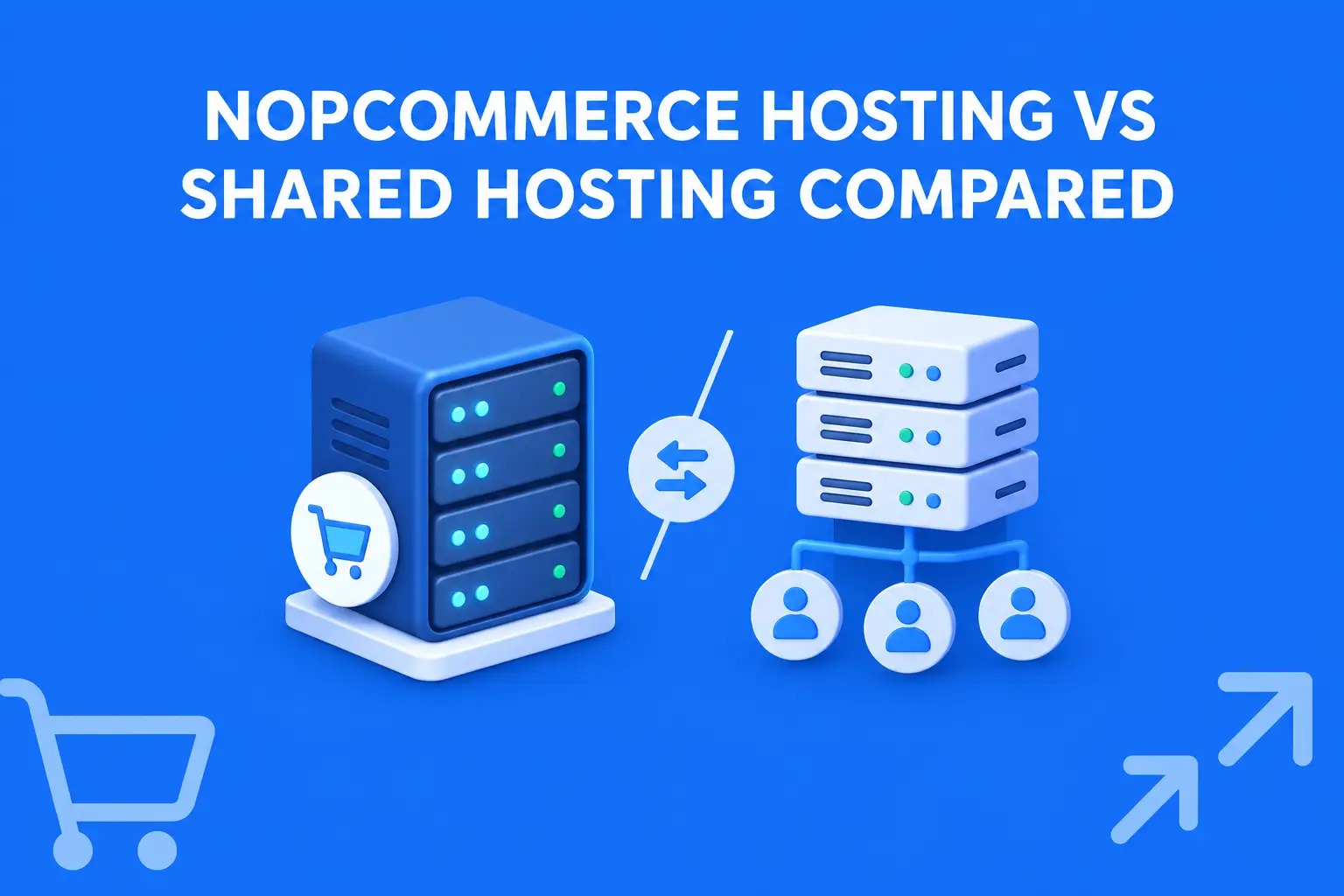
What separates nopCommerce hosting from shared hosting?
Shared hosting places many websites on one server and divides server capacity among them. Each account has a portion of the available CPU, memory, storage, and database resources. This model keeps entry costs low, but activity from other accounts can affect the resources available to your store. The host usually controls most server settings, software configuration, monitoring, and upgrade policies.
Specialized nopCommerce hosting is designed around the platform's requirements and the realities of operating an online store. It commonly uses a VPS or VDS environment with dedicated or clearly allocated resources, Windows and ASP.NET Core configuration, SQL Server support, scheduled backups, performance monitoring, and technical support that understands nopCommerce deployments.
The difference is not merely whether the site has more disk space. It is whether your store has an environment that can be configured around its application, database, integrations, traffic patterns, and growth plan.
nopCommerce Hosting vs Shared Hosting for Performance
Page speed depends on more than a hosting plan, but hosting sets the ceiling. nopCommerce processes requests through an application layer, queries product and customer data from a database, runs plugins, applies discounts, calculates shipping, and often communicates with third-party services. A busy storefront asks considerably more from a server than a brochure site.
On shared hosting, CPU and memory limits may be difficult to predict. A neighboring site experiencing a traffic spike, a resource-heavy backup process, or a restrictive account policy can leave your application with less capacity. Common symptoms include slower category and search pages, delayed admin actions, checkout timeouts, and periodic errors during imports or scheduled tasks.
A nopCommerce-focused VPS or VDS gives the store more consistent compute and memory capacity. That matters when product feeds are generated, inventory is synchronized, search indexes are rebuilt, or marketing traffic arrives in a short window. It also allows the environment to be tuned for the application rather than held to generic shared-hosting defaults.
Performance gains still require proper implementation. Large product images, inefficient custom code, excessive plugins, and poorly planned database queries can slow down a store on any server. The advantage of specialized hosting is that the infrastructure can be evaluated alongside the application. Instead of treating a slow store as a mystery, a technical team can isolate whether the issue sits in server resources, SQL performance, caching, third-party requests, or storefront code.
The database is often the deciding factor
For many growing stores, database performance becomes more noticeable than basic page delivery. nopCommerce uses SQL Server to manage catalog data, orders, customers, pricing rules, and operational records. As the catalog, order history, and integration activity grow, database response time directly affects storefront and admin performance.
Shared plans may place database services under tight limits or provide little control over maintenance and configuration. A dedicated environment offers more room to plan database capacity, backups, monitoring, and optimization. This is especially relevant for stores with complex product attributes, customer-specific pricing, large order volumes, or frequent ERP and CRM synchronization.
Security and reliability have revenue implications
Every eCommerce store handles sensitive customer data and business-critical processes. Even when a payment gateway processes card details offsite, the storefront, customer accounts, order data, administrative access, and integrations still require protection.
Shared hosting providers may offer SSL certificates, basic backups, and general server security. Those services are useful, but they are often standardized for a broad range of websites. A nopCommerce store may need more specific controls: controlled FTP or file access, restricted admin permissions, firewall configuration, malware monitoring, backup retention, application updates, and a documented recovery process.
Reliability also means knowing what happens when something fails. If a plugin update conflicts with the current nopCommerce version, an import overloads the server, or an integration begins returning errors, a generic support desk may only confirm that the server is online. A hosting partner with nopCommerce expertise can investigate the relationship between infrastructure, application logs, scheduled tasks, plugins, and SQL activity.
No hosting setup eliminates risk. Managed infrastructure is still dependent on timely platform upgrades, secure credentials, disciplined extension selection, and tested backups. The practical goal is to reduce preventable downtime and shorten recovery when an issue occurs.
Scalability is about more than traffic
Many merchants associate scaling with a sudden increase in visitors. Traffic matters, particularly during promotions, seasonal peaks, or B2B ordering cycles. Yet store complexity can create infrastructure pressure even when visitor counts remain moderate.
A store may need more resources because it adds a second language, introduces a wholesale portal, expands to multiple stores, connects an ERP, or launches a large catalog feed for Google and Facebook. GA4 tracking, Klaviyo automation, shipping integrations, and real-time stock updates also add requests that need reliable processing.
Shared hosting generally makes this type of growth harder to plan. There may be a fixed limit on background processes, storage operations, database use, or server-level adjustments. Moving later can also be disruptive if hosting and development teams do not coordinate the deployment, DNS changes, files, database, SSL certificate, and post-launch validation.
With specialized nopCommerce hosting, resource upgrades can be planned around commercial events and technical milestones. A merchant can increase capacity before a campaign, isolate a staging environment for testing, or prepare a migration before an outdated platform version becomes a business risk. That control supports more deliberate growth rather than reactive troubleshooting.
When shared hosting can still make sense
Shared hosting is not automatically the wrong choice. For a new nopCommerce store with a small catalog, low order volume, minimal customization, and no heavy integrations, it can provide an affordable way to validate a concept. It may also suit a temporary development site or a small regional operation with predictable demand.
The key is to treat it as a deliberate starting point, not a permanent assumption. Review actual usage before performance becomes visible to customers. Check page load times during peak periods, server resource alerts, backup success, database response, error logs, and the impact of scheduled jobs. If administrative tasks are slowing down or the storefront becomes inconsistent under ordinary demand, the lowest monthly price is no longer the lowest operational cost.
How to choose the right environment
Start with the store you are operating over the next 12 to 24 months, not only the store you have today. Estimate catalog size, expected traffic, peak campaign periods, order growth, integrations, custom plugins, and whether you need multi-store or B2B capabilities. Then consider who will maintain the environment after launch.
Ask hosting providers direct operational questions. Can resources be increased without a full rebuild? How are backups stored and restored? Is there staging support? Who investigates application-level errors? Can the environment support your required nopCommerce version, SQL Server workload, and scheduled tasks? What access does your technical team retain?
For stores that depend on custom workflows or connected business systems, specialized support has practical value. A provider such as noptech can align hosting with custom development, upgrades, plugin compatibility, and ongoing maintenance so the store is managed as one commerce system rather than a collection of separate vendors.
Plan the move before performance becomes urgent
Migrating from shared hosting does not need to be a crisis project. A well-managed move begins with an inventory of files, database size, nopCommerce version, plugins, integrations, scheduled tasks, DNS records, SSL requirements, and current performance issues. The store should be tested in the new environment before the production switch, with special attention to checkout, payment processing, email delivery, search, order management, and third-party data flows.
Schedule the cutover outside peak sales periods, keep a rollback plan, and monitor application logs after launch. This approach protects customers while giving the business a clearer baseline for performance and reliability.
The right hosting choice should give your team room to sell, market, integrate, and improve the store without wondering whether the server will keep up. Choose infrastructure before it becomes the bottleneck.