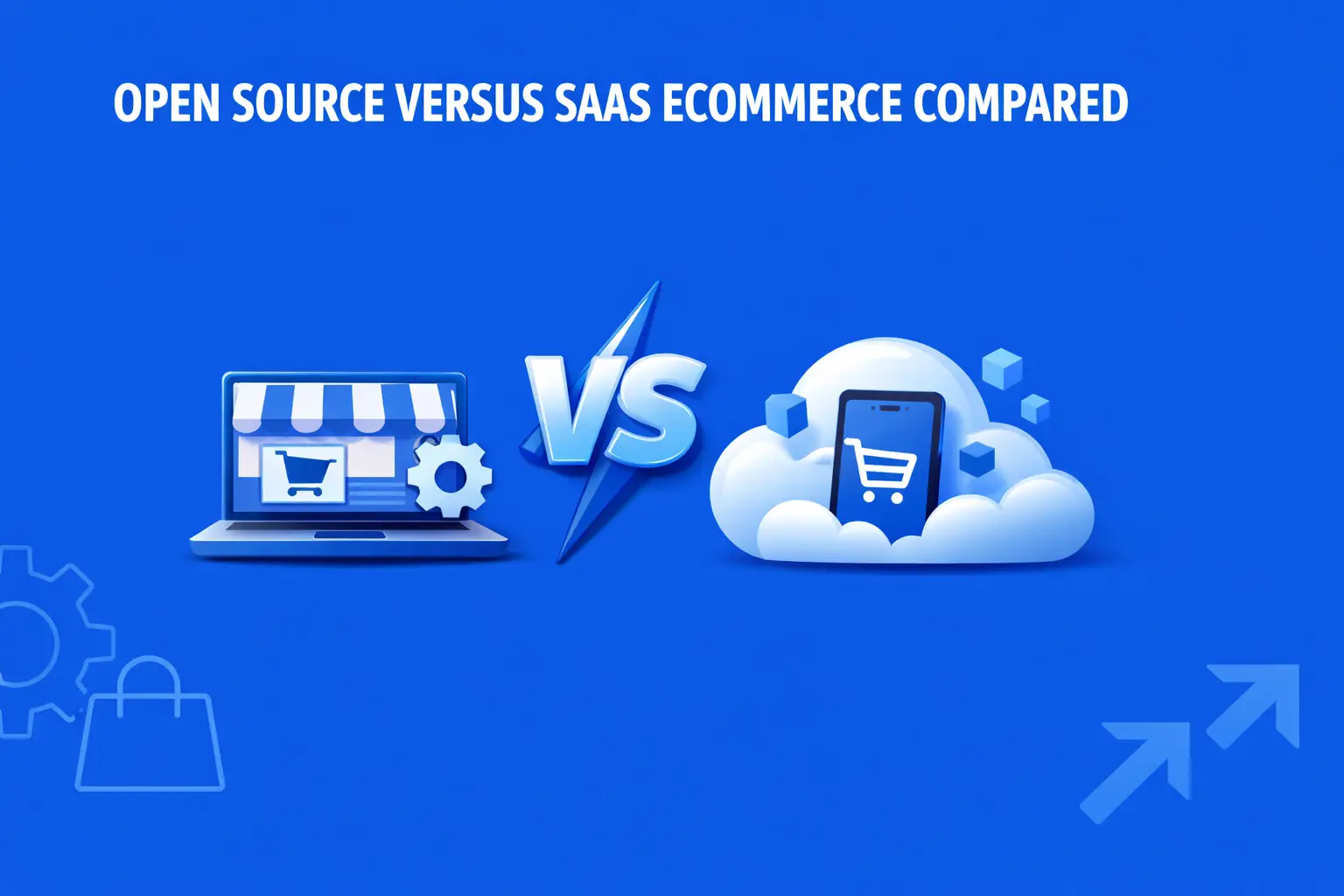
A commerce platform decision becomes very real when a new ERP connection is delayed, checkout rules cannot support a B2B account structure, or page speed drops during a major campaign. Open source versus SaaS ecommerce is not simply a choice between two types of software. It is a decision about who controls your technology, where operational responsibility sits, and how far your store can adapt as the business grows.
For some merchants, a SaaS platform removes enough technical overhead to justify its limits. For others, particularly businesses with complex catalogs, custom workflows, multi-store requirements, or connected back-office systems, owning the application layer delivers a better long-term fit. The right answer depends on the operational reality behind your storefront, not the size of your business alone.
Open Source Versus SaaS Ecommerce: The Core Difference
SaaS ecommerce platforms are delivered as a hosted service. The vendor operates the underlying infrastructure, maintains the core application, and releases platform updates on its schedule. Merchants typically configure the store through an admin panel, theme tools, approved apps, and vendor-supported APIs. This model can reduce the work required to launch and maintain a standard online store.
Open-source ecommerce platforms provide access to the application source code. Your business can host the platform in an environment it controls, modify functionality, build custom integrations, and determine when to upgrade. nopCommerce is an example of an open-source platform designed for merchants that need a capable commerce foundation with room for tailored development.
The practical distinction is control. A SaaS vendor controls the platform roadmap, infrastructure rules, and many technical boundaries. With open source, your team controls the architecture, but also takes responsibility for hosting, monitoring, security updates, testing, and development quality. Neither model is automatically better. Each shifts cost, risk, and opportunity to a different place.
When SaaS Ecommerce Is the Better Fit
SaaS can be a smart choice for a merchant with a straightforward product catalog, limited internal technical resources, and a near-term need to launch. Hosting, baseline security maintenance, and standard platform updates are typically included in the subscription. This reduces the number of vendors and technical decisions required on day one.
It also works well when the business can operate within the platform's native checkout, promotion, product, and customer-account capabilities. Many SaaS platforms offer mature app marketplaces that cover common requirements such as email marketing, reviews, subscriptions, shipping labels, and basic reporting. If an approved application meets the need without creating performance or data-management issues, configuration may be faster than custom development.
The trade-off appears when the store must depart from the platform's intended operating model. A merchant may need customer-specific pricing calculated from ERP data, an approval workflow before purchase orders are submitted, a custom product configurator, or a checkout that handles unusual fulfillment rules. SaaS platforms may support some of these requirements through extensions, APIs, or enterprise plans. However, the result can become expensive, fragmented, or constrained by vendor policies.
SaaS is also less attractive when a platform change would materially disrupt operations. If business-critical processes depend on vendor-specific apps and proprietary storefront features, the merchant has less control over future pricing, product changes, and migration timing.
Why Open Source Creates More Strategic Options
Open source is often selected because a store needs to fit the business rather than asking the business to fit the platform. The source code can be extended at the application level, allowing developers to build capabilities that are specific to the merchant's catalog, customers, fulfillment model, or internal systems.
For a B2B seller, that may mean company accounts with multiple buyers, purchasing roles, quote requests, contract pricing, credit limits, and account-level order approval. For a multichannel retailer, it may mean a central product-data process that feeds multiple storefronts, marketplaces, warehouses, and marketing systems. For an enterprise operation, it may mean connecting ecommerce to an existing ERP, CRM, PIM, tax engine, warehouse management system, and analytics stack without relying on a collection of loosely connected apps.
Open source also gives businesses greater control over performance architecture. A store can use dedicated VPS or VDS resources, configure caching around its traffic patterns, manage database performance, and set deployment practices that match its release cycle. These details matter when traffic volume rises, catalogs expand, or integrations perform large data exchanges.
That flexibility has a cost. Customization should be designed carefully, documented, tested, and maintained through platform upgrades. Poorly written extensions, unsupported changes to core files, and unmonitored hosting can turn flexibility into technical debt. Open source delivers the best results when the merchant treats its store as a managed business system, not a one-time website project.
Cost Is More Than a Monthly Platform Fee
Comparing license or subscription fees alone leads to an incomplete decision. SaaS costs are generally predictable at the start, but total spend can increase through transaction fees, premium plans, paid apps, development work, and pricing tied to revenue or features. A low initial subscription does not always remain low as operational requirements become more sophisticated.
Open-source costs are distributed differently. The core software may not carry a recurring license charge, but the business must budget for hosting, implementation, custom development, security maintenance, monitoring, backups, upgrades, and support. Those costs are investments in a stack the merchant controls, yet they need active management.
The useful question is not, “Which platform is cheaper?” Ask which model produces the lowest total cost for your required level of functionality, performance, and operational reliability over the next three to five years. A simple direct-to-consumer store may find SaaS economical for a long time. A business paying for multiple workarounds, manual exports, and disconnected systems may find that open source reduces operational cost even when the initial implementation is higher.
Security and Reliability Require Different Ownership Models
SaaS providers usually manage infrastructure security, core platform patching, and availability at the service level. That can provide welcome assurance for teams that do not want to run servers or manage application updates. Merchants still need to control user permissions, protect admin accounts, review third-party applications, and maintain sound data practices.
With open source, the responsibility is broader but more controllable. The hosting environment must be hardened, backups tested, access managed, and updates applied on a planned schedule. Payment processing should be implemented in a way that limits unnecessary exposure to cardholder data. Security logs, uptime monitoring, malware scanning, and a documented recovery process should be part of ongoing operations.
A managed open-source environment can give merchants a strong balance: infrastructure and maintenance are handled by specialists, while the business retains ownership of its application, data, and development roadmap. The key is defining who owns each responsibility before launch, not after an incident or failed update.
Evaluate Integrations Before You Select a Platform
Most ecommerce projects do not fail because a platform cannot display products or process a standard payment. They struggle because data and processes do not move reliably between systems. Inventory is out of sync, customer records are duplicated, shipping rules are inconsistent, or marketing teams cannot trust conversion data.
Before choosing between SaaS and open source, map the systems your store must connect to and the data each connection must exchange. Include ERP, CRM, PIM, accounting, payment gateways, shipping providers, tax services, marketing automation, GA4, and advertising feeds. Then identify whether each integration needs real-time data, scheduled synchronization, one-way exports, or custom business rules.
This exercise often clarifies the decision quickly. If standard connectors satisfy the process, SaaS may offer an efficient route. If your operation needs custom data mapping, specialized order logic, or integration behavior that changes by customer, product, warehouse, or region, open-source development is usually more practical.
Choose the Operating Model You Can Support
The most successful platform choice aligns with your team's ability to govern it. A SaaS store needs clear ownership of configuration, app selection, content, merchandising, and data quality. An open-source store needs those capabilities plus a reliable technical operating model for releases, hosting, performance, integrations, and support.
That does not mean an ecommerce company needs a large internal development department to use open source. It means the company needs accountable technical expertise, whether in-house or through a specialized partner. noptech supports nopCommerce stores across that lifecycle, from custom development and integrations to managed hosting, upgrades, and ongoing optimization.
Start with the operational bottlenecks your new platform must solve, then test each platform model against those requirements. The best decision is the one that gives your team enough speed for the present and enough control to keep improving the store when growth makes standard functionality no longer standard.